A short report on the 1998 excavation campaign
The 1998 campaign, the eleventh since the beginning of the new series of excavations,
lasted from June 15 through August 31. At the peak of the season we counted once more up to 70 participants from eleven countries.
In the coming years this number and the extent of excavation activities will decrease owing to the changes in emphasis: Final
publication, Troia-Exhibition, installation of the planned new museum and the historic Troia-National Park.
Ten areas were excavated and seven sections of the site were restored, two of them for aid to visitors.
The Bronze Age:
Troy I-III (ca. 2600 - 2300 B.C.)
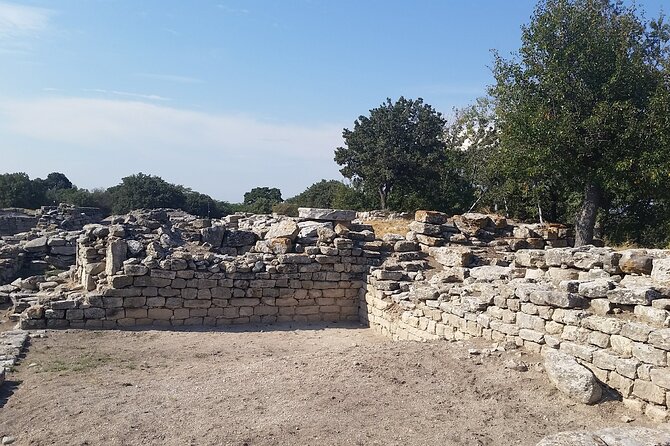
Excavation in a key section of E/F4 aimed at a clarification of the architectural
transition from late Troia I to Troia II, a complex series of building phases originally revealed by Schliemann/Dörpfeld and
Blegen. Following the results of 1998 we have to add several additional phases to late Troia I to eliminate present inconsistencies.
In quadrat G6 excavation of an intact area containing undisturbed structures from Troia
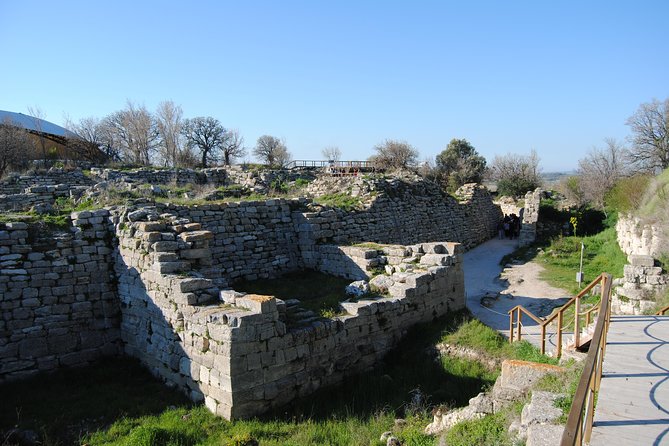
VI down to Troia II was continued from 1997. This year inside the defense wall of Troia II we uncovered the remains of a phase
IIh megaron with plastered walls, a central circular hearth, and important finds like a cult amphora with idols in adoration
gestures on the handles. For 1999 we expect to complete the excavation of the building and the confirmation of its character
as a place of cult with a well preserved inventory.
Troy VI-VIa (ca. 1700 - 1150 B.C.)
We concluded the 1997 sondage inside the Northeast Bastion searching to
answer significant questions concerning Troy's water supply. For reasons of safety we had to stop before we reached the bottom
of the well. Analyzing the fill so far we can state that the well went out of use at the latest in Troia VIIb2.
In the west of the Lower City the cave with a spring was unsuccessfully searched for finds allowing
to date its earliest use as a fountain. Likewise the water conduits and basins found at the exit from the cave so far have
not yielded proof of usage in the bronze age. Both operations will continue in the coming year.
Investigation of areas KL16/17 in the Lower City earlier had already uncovered sections
of "negative architecture", the foundation for a wooden palisade cut into the bedrock. In 1998 our excavation in this area
uncovered the rest of the gate installation of this palisade. Analyzing the fill of the postholes of the bulwark we discovered
as a big surprise that they contained sherds of Troia I/II. Hence this structure has to be assigned to the first great period
of Troia i.e. that of the Maritime Culture of the "treasure horizon" in the middle of the 3rd mill. B.C. Thus the previous
view of a larger settlement in the environs of the citadel is solidified. Beginning with Early Troia VI after the clearing
of the bulwark down to bedrock wooden houses appear with changing construction characteristics through the late bronze age
period. They were followed by distinct settlement structures no sooner than the Hellenistic period.
Post-Bronze Age:
Troy VIII-IX
1998 marked the conclusion of excavation activities of the Post-Bronze
Age group at Troia. Examination of the evidence, however, will continue several years until the final publication.
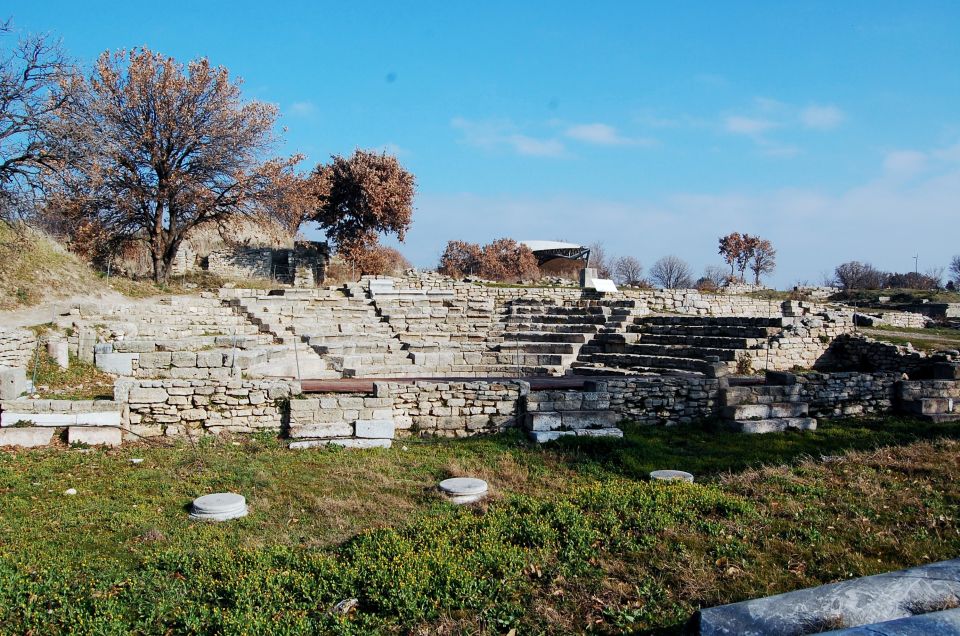
Activities concentrated on the area of the Odeion and the Bouleuterion which resulted
in a clearer understanding of the terracing of the acropolis from Archaic to late Hellenistic periods. Furthermore for the
first time we found Hellenistic building structures in the center of the Lower City and above the great theatre. The excavation
in area t/u15 was accompanied by dating the sparse finds from within the various parts of the cave and from the water basins
in front of the cave. So far all of them point to the Roman period.
A larger project
was started outside of Troia at the tumulus of Besik-Sivritepe which has been severely demolished by robbing sondages in the
recent years. After initially investigating the use of a horizontal robbing tunnel it was decided for safety reasons to dig
a vertical shaft from the top in search of a burial chamber. So far the construction scheme of the tumulus consisting of horizontal
layers has been verified. The investigation will be concluded next year.